Timing tool
Planetary hours today, live for your city.
Times for New York
Another city
Type at least 3 letters, then choose your place in the list.
Every hour of the day belongs to one of the seven classical planets. It is one of the oldest timing tools we have, and the math is simple: your real sunrise and sunset, cut into twelve. Here is the hour you are in right now, the full day, and what each hour is good for.
How planetary hours work
Take the time between sunrise and sunset and cut it into 12 equal parts: those are the day hours. Do the same from sunset to the next sunrise: those are the night hours. So a planetary hour is almost never 60 minutes.
The math: in Paris, a day hour lasts 81 minutes on 21 June and only 41 minutes on 21 December. In New York, 75 and 46 minutes. That is why a list printed for another city, or a fixed hour grid, is wrong for you.
Why Saturday belongs to Saturn
The first hour after sunrise belongs to the planet of the day: Sun on Sunday, Moon on Monday, Mars on Tuesday, Mercury on Wednesday, Jupiter on Thursday, Venus on Friday, Saturn on Saturday.
Then the hours follow the old order of the planets, from the slowest to the fastest: Saturn, Jupiter, Mars, Sun, Venus, Mercury, Moon, and again. Count 24 hours from Saturn on Saturday and you land on the Sun at the next sunrise. That is where the names of our weekdays come from.
What each hour is good for
Sun: being seen, asking the boss, anything about your name. Moon: home, family, small errands. Mercury: emails, contracts, study, sales. Venus: love, beauty, making peace. Mars: sport, hard talks, cutting something off. Jupiter: money, growth, asking a mentor. Saturn: long work, structure, finishing what lasts.
Use it as a small extra, not as a rule. Send the important email in a Mercury hour, ask for the raise in a Jupiter or Sun hour. When the day itself is badly chosen, a good hour does not save it: for big dates, start with the full election.
Example: Apollo 11, launched in the hour of Saturn
Apollo 11 lifted off from Cape Canaveral on 16 July 1969 at 9:32 am local time. It was a Wednesday, the day of Mercury, the planet of travel and messages.
Sunrise was at 6:35 am and a day hour lasted 69 minutes. So 9:32 am fell in the third hour of the day: the hour of Saturn, the planet of long, hard, structured work. The rocket was a Saturn V. We did not plan that, NASA did not either, but the math says so.
Read it with your birth chart
1. Find the planet that rules your Ascendant: its hour is your hour, a good moment to start something for yourself.
2. Find the planet of your year (your profection lord): its hours are the strongest for this year's topic.
3. Avoid starting important things in the hour of a planet that is retrograde today: the tool shows the hour, the sky calendar shows the retrogrades.
Pick a good date, not only a good hour
The electional tool checks the Moon, the retrogrades and the angles for a launch, a wedding or a move.
Open the date pickerKeep reading
The Titanic and the Sky of April 1912: Mercury Retrograde, Two Eclipses and the Warnings That Did Not Get Through
COVID-19 and the Sky of 2020: the Saturn-Pluto Conjunction, Mars in Capricorn and the Great Conjunction
AIDS and the Sky of 1981-1985: Saturn Stops on the Day of the First Report, Then Meets Pluto in Libra
Air France 447 and the Sky of June 2009: Jupiter Meets Neptune, Mercury Stops, and the Readings Go False
Free class
Learn to read your birth chart yourself
Short visual lessons, 10 minutes a day, with a quiz at the end. Level 1 is free, no account needed.
This method, on your own 2027
Read about it here. Live it in your agenda.
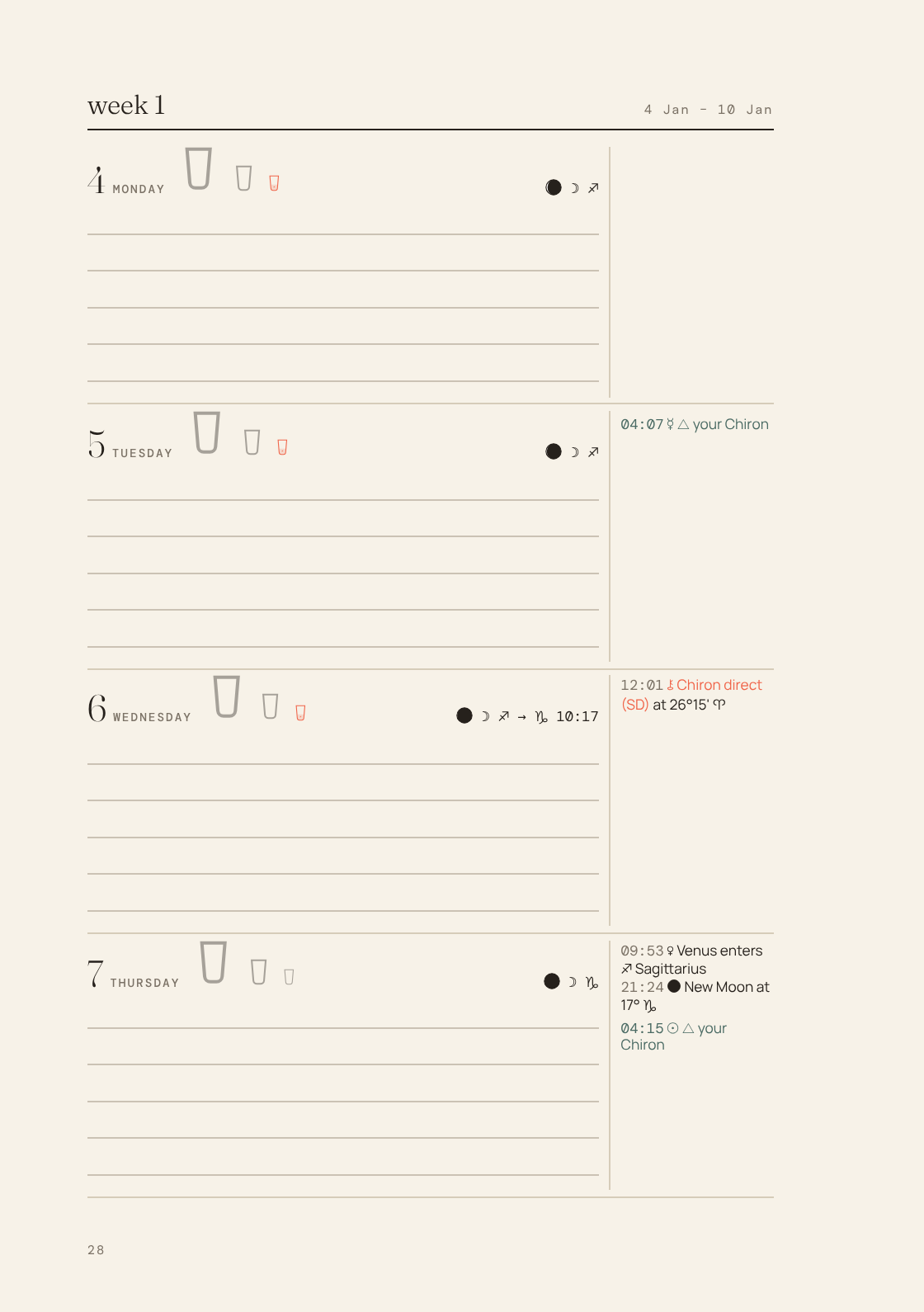
Your personalized 2027 agenda uses this kind of timing on your birth chart and writes the result day by day, in plain words. Your strong days, every Moon on the right day. A PDF to print, ready in one minute.
Questions about planetary hours
How are planetary hours calculated?
The time from sunrise to sunset is cut into 12 equal day hours, and the time from sunset to the next sunrise into 12 night hours. The first day hour belongs to the planet of the weekday, then the order is Saturn, Jupiter, Mars, Sun, Venus, Mercury, Moon.
Why is a planetary hour not 60 minutes?
Because days are long in summer and short in winter. In Paris, a day hour lasts 81 minutes in June and 41 minutes in December.
What is the planetary hour right now?
Open this page: the tool computes it live from your city's real sunrise and sunset, and shows the whole day.
What is the best planetary hour for money?
Classically Jupiter for growth and asking, Mercury for contracts and sales, Venus for pleasant deals. Pick the hour inside a day that is already well chosen.